Well, it has been pretty much a full month since I last posted. Mostly because it has been hurringly cold! That means most days are spent wrapped up in several afghans, with a warm hat, fuzzy scarf, and fingerless gloves, hugging a hot water bottle. Very hard to do anything craft-y like that! So, yes, I am WAY behind in all my embroidery stuff. And I haven't really done a lot else either - just a lot of reading and knitting a big warm afghan with large needles.
I did manage to knit a cute Minion hat last week on 4mm needles - I was bored and in the mood for a goofy hat.
Towards the beginning of the month I made my first ravioli - it was fantastic. Filled it with my homemade ricotta cheese. I do like the homemade pasta!
When I made the pasta dough (on the last post), I only made half a recipe, but got 7 meals out of it. 3 cups of flour and 3 eggs - 7 meals. Coupled with freshly made home-made ricotta cheese (2 litres of milk), my ultra-fast home made pasta sauces (a tomato one - buy 1 tin budget tomatoes, and 1 tin budget tomato puree; and a creamed greens one), and fresh veggies from the garden for sides, salads and the sauces, I managed to do a week's worth of dinners, surprisingly fast and easy, for a grand total of $7.00. Now that's economical!
I also broke into the first of my hard cheeses - the beer cheese. Oh wow! it was wonderful! Especially with my freshly baked peasant bread, and a glass of my homemade cider.
What I am most excited about though, is the violet blossom jelly I made today.
I can see why it is very rarely done anymore - very time consuming, down on the ground, picking 4 cups of violet flowers!
My garden is overrun with violets, and I regularly pull bucketfuls of the plants out trying to keep the garden clear and stop them overrunning and killing everything else in the garden. Unfortunately, the violets I have are the white ones - no scent at all. Bummer. My neighbour down the back though has a small patch of beautifully scented rose-coloured violets. They are just heavenly! She let me raid her violet patch yesterday for the flowers. I completely stripped the patch of flowers, and just managed to get enough.
After half an hour getting all the ants off the blossoms, I then steeped them in boiling water, left them to cool, and left them to steep overnight. Boy do ants LOVE violets! I put a plate over the bowl to keep 'things' out (you know, all the 'stuff' that invariable fall into whatever you are trying to cook if you don't cover it), and when I came back to check on the flowers an hour after pouring the hot water on, the whole bench was just covered in ants! They were all trying to get into the bowl to get to the violet water. Needless to say, I had to move the bowl to where the ants couldn't get to it.
So this morning I made up the jelly. Ooooo! Heavely! Very delicate flavour, and DEFINATELY worth the effort!
Showing posts with label Preserving. Show all posts
Sunday, 31 August 2014
Friday, 1 August 2014
Playing with Pasta and Cheese
The days are still dawning bright and clear, but the crisp is gone, and the afternoon breezes are downright balmy. I was expecting a long winter and late, cool spring, but I think spring may actually have sprung. Further evidence of this are the aphid and the whitefly infestations that have appeared on the brassicas, typical of spring, but not generally of warm winter periods. Looks like brassica season is coming to an end.
This week's cheese is Wensleydale. Wensleydale is a hard cheese, somewhat sweetish, generally served with fruit and dessert wines. It often has dried cranberries in it. Dried cranberries are hurringly expensive, but since you don't use that much, I decided to go ahead and put them in. Pak n Save has a small bulk foods section stocking things from a range called 'Alison's Pantry' - stuff Alison Holst promotes for her baking and recipes. In that range are the most heavenly orange flavoured cranberries (natural orange flavouring, not artificial). They smell so divine, and taste just as wonderful! I absolutely love them, but rarely buy them because of the price. However since I only needed a handful of cranberries for the cheese, I splashed out and got these instead of regular dried cranberries, and it worked out to nice small sum of just under $2.50. They smelled so wonderful as I mixed them into the curd, and you just know the subtle orange flavour is going to permeate the cheese as it ages. This one is going to be fantastic.
A couple of months ago, a book on pasta making that I have wanted since forever on Fishpond (NZ's version of Amazon) dropped in price by 60% for a short time, so I jumped at the chance to get it. It was finally shipped just on a week ago, and should be arriving any day.
So while I was waiting the 1 & 1/2hrs for the curds to drain, I decided to give pasta making a bit of a go as well. I can't believe how fast and easy it is to do handmade pasta! Of course it was just basic, a bit of a play to see how it went, in preparation for getting into it for real, but still. Including the 1/2hr resting time for the dough, I had it made, cooked and eaten by the time the curds had drained and were ready for pressing. Wow!
I now know what real 'al dente' is. With the dried pasta, I find that generally means 'not quite cooked', but with fresh pasta it is quite different. And I can also see why it was such a staple food for so long. Being as much egg as flour, it is very high in protein, and when smothered in (home-made) vegetable laden sauces, it packs quite a nutritional whollop. It is also LOADS more filling than the dried pastas. I only made half a dough recipe, only cut 1/4 of that into noodles and cooked them, and still could only eat half the meal. Definitely fresh pasta is going to become a staple for me, coupling nicely with my home-made cheeses, and home made sausages. Yum!
Freshly made pasta, with creamed greens (kale, flower sprout, komatsuna, perpetual beet, red silverbeet, yellow silverbeet - all freshly picked from my garden), topped with my grated home-made Ricotta Salata, and a steamed Romanesco broccoli from the garden.
This week's cheese is Wensleydale. Wensleydale is a hard cheese, somewhat sweetish, generally served with fruit and dessert wines. It often has dried cranberries in it. Dried cranberries are hurringly expensive, but since you don't use that much, I decided to go ahead and put them in. Pak n Save has a small bulk foods section stocking things from a range called 'Alison's Pantry' - stuff Alison Holst promotes for her baking and recipes. In that range are the most heavenly orange flavoured cranberries (natural orange flavouring, not artificial). They smell so divine, and taste just as wonderful! I absolutely love them, but rarely buy them because of the price. However since I only needed a handful of cranberries for the cheese, I splashed out and got these instead of regular dried cranberries, and it worked out to nice small sum of just under $2.50. They smelled so wonderful as I mixed them into the curd, and you just know the subtle orange flavour is going to permeate the cheese as it ages. This one is going to be fantastic.
| Just out of the press, to be turned, redressed and put back overnight at 20kg pressing weight. |
A couple of months ago, a book on pasta making that I have wanted since forever on Fishpond (NZ's version of Amazon) dropped in price by 60% for a short time, so I jumped at the chance to get it. It was finally shipped just on a week ago, and should be arriving any day.
So while I was waiting the 1 & 1/2hrs for the curds to drain, I decided to give pasta making a bit of a go as well. I can't believe how fast and easy it is to do handmade pasta! Of course it was just basic, a bit of a play to see how it went, in preparation for getting into it for real, but still. Including the 1/2hr resting time for the dough, I had it made, cooked and eaten by the time the curds had drained and were ready for pressing. Wow!
I now know what real 'al dente' is. With the dried pasta, I find that generally means 'not quite cooked', but with fresh pasta it is quite different. And I can also see why it was such a staple food for so long. Being as much egg as flour, it is very high in protein, and when smothered in (home-made) vegetable laden sauces, it packs quite a nutritional whollop. It is also LOADS more filling than the dried pastas. I only made half a dough recipe, only cut 1/4 of that into noodles and cooked them, and still could only eat half the meal. Definitely fresh pasta is going to become a staple for me, coupling nicely with my home-made cheeses, and home made sausages. Yum!
![]() |
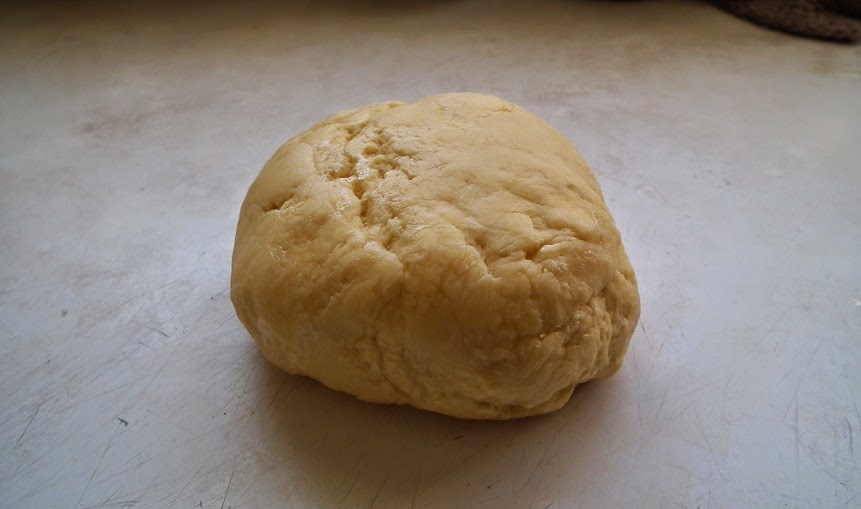
| Here is my first pasta dough |
| My first noodles. |
Freshly made pasta, with creamed greens (kale, flower sprout, komatsuna, perpetual beet, red silverbeet, yellow silverbeet - all freshly picked from my garden), topped with my grated home-made Ricotta Salata, and a steamed Romanesco broccoli from the garden.
Sunday, 20 July 2014
Rainy Sunday
Yay! I was finally able to bottle my cider on Friday. The brewing took inordinately longer than it was supposed to, because winter finally decided to make a showing and the temperatures plummeted. I only managed to finally get it done by huddling my poor brew up to the fireplace. Even then, with wood reserves low, I was lucky to get it up to 18C (64.4F). In the end I wrapped it up in a towel for insulation and managed to get it up to 20C (68F). So now it is bottled, and sitting in a dark corner for aging.
My Gorgonzola isn't terribly happy about the cold either (the kitchen fluctuating between 4C (39.2F) at night and up to 12C (53.6F) - if we are lucky - in the day), and is protesting by flatly refusing to grow blue mould. Italians can be so fussy! My Beer Cheese however, being a true Brit with true grit, doesn't seem to mind the cold at all. It is happy, healthy, and cheerfully sprouting mould - unfortunately it's not the one that is supposed to be growing the mould! Never mind. Since it has developed a good rind, I have wiped it down with salt water to remove the mould, and waxed it this morning. Now it goes up to age for 6 weeks.
Meanwhile I have a Neufchatel draining in the kitchen. Neufchatel generally doesn't mind the colder weather, so I should have a nice cheese for my bread in about two weeks. With the wind and rain still persisting, and an endless grey sky indicating it will be like that that for a while yet, I think I will bake bread and make some Mozzarella today as well, before settling in to an afternoon of embroidery.
My Gorgonzola isn't terribly happy about the cold either (the kitchen fluctuating between 4C (39.2F) at night and up to 12C (53.6F) - if we are lucky - in the day), and is protesting by flatly refusing to grow blue mould. Italians can be so fussy! My Beer Cheese however, being a true Brit with true grit, doesn't seem to mind the cold at all. It is happy, healthy, and cheerfully sprouting mould - unfortunately it's not the one that is supposed to be growing the mould! Never mind. Since it has developed a good rind, I have wiped it down with salt water to remove the mould, and waxed it this morning. Now it goes up to age for 6 weeks.
Meanwhile I have a Neufchatel draining in the kitchen. Neufchatel generally doesn't mind the colder weather, so I should have a nice cheese for my bread in about two weeks. With the wind and rain still persisting, and an endless grey sky indicating it will be like that that for a while yet, I think I will bake bread and make some Mozzarella today as well, before settling in to an afternoon of embroidery.
| 2 of my cider, and my freshly waxed Beer cheese. |
Tuesday, 15 July 2014
Cheesy Chusday
The Chorizo turned out fantastic! I'm thrilled I am able to do sausages now, as I had given up totally on pre-made sausage, with their preponderance of large pieces of gristle. The final straw was several years back when I thought I would try some 'gourmet' sausages that had come on the market from a local artisan place (having given up on standard store-bought almost a decade before). Wow - the gristle pieces were even bigger than standard sausages. Then came the real crunch - literally! I cracked a tooth on a very large piece of bone in the sausage. Gourmet? For Klingons maybe, but I certainly wouldn't class them as even edible, much less gourmet.
Meanwhile, here we are over half way thru winter, and winter has finally actually set in. Brrrr! I am hoping for a sunny day soon, so I can bottle my cider. At the moment it is WAY too cold in the kitchen to do much of anything. Even putting the jug on is a quick dash before rushing back into the lounge and the warm fire. Oh, what I wouldn't give for a wood stove! Fortunately, the entire long 'outside' wall of the kitchen is mostly window, and faces the sunny side all day, so even in winter, when it is sunny it warms up real fast.
The last two sunny days we had I made the cheeses I had been waiting to make. On the first sunny day I did the Gorgonzola, which is a blue cheese. It is the oldest (i.e. first) blue cheese, reputed to date back to ancient Rome. Blue cheeses are quite fiddly to make, this one needing 10 hours set aside for it.
I only like blue cheeses when they are relatively 'fresh'. Unfortunately, even the 'fresh' ones in the shops are not at all fresh. Not that I can actually afford to buy them anyway. The last small (and I do mean small!) piece I bought for a pasta dish was 50g (1.76 oz) and cost almost $9.00! So making my own now is a real boon. Blue cheese dressing, blue cheese pasta sauce, ... mmmm...
Two days later we got another sunny day and I was able to do the Beer Cheese. This is a hard cheese that will be waxed for aging. For this one I soaked the curds in a Cooper's Best Extra Stout, a wonderful, rich, aromatic brew. Cooper's is a great Aussie artisan style beer - my favourite brand for using in breads, cheeses, meat dishes, and stews.
On the left is the Beer Cheese wheel, air drying in preparation for waxing. On the right are the Gorgonzola wheels, salted and ready for maturing to develop the mould, after which they will be wrapped and aged for a scant 4 weeks to produce a wonderful fresh blue cheese.
Meanwhile, here we are over half way thru winter, and winter has finally actually set in. Brrrr! I am hoping for a sunny day soon, so I can bottle my cider. At the moment it is WAY too cold in the kitchen to do much of anything. Even putting the jug on is a quick dash before rushing back into the lounge and the warm fire. Oh, what I wouldn't give for a wood stove! Fortunately, the entire long 'outside' wall of the kitchen is mostly window, and faces the sunny side all day, so even in winter, when it is sunny it warms up real fast.
The last two sunny days we had I made the cheeses I had been waiting to make. On the first sunny day I did the Gorgonzola, which is a blue cheese. It is the oldest (i.e. first) blue cheese, reputed to date back to ancient Rome. Blue cheeses are quite fiddly to make, this one needing 10 hours set aside for it.
I only like blue cheeses when they are relatively 'fresh'. Unfortunately, even the 'fresh' ones in the shops are not at all fresh. Not that I can actually afford to buy them anyway. The last small (and I do mean small!) piece I bought for a pasta dish was 50g (1.76 oz) and cost almost $9.00! So making my own now is a real boon. Blue cheese dressing, blue cheese pasta sauce, ... mmmm...
Two days later we got another sunny day and I was able to do the Beer Cheese. This is a hard cheese that will be waxed for aging. For this one I soaked the curds in a Cooper's Best Extra Stout, a wonderful, rich, aromatic brew. Cooper's is a great Aussie artisan style beer - my favourite brand for using in breads, cheeses, meat dishes, and stews.
On the left is the Beer Cheese wheel, air drying in preparation for waxing. On the right are the Gorgonzola wheels, salted and ready for maturing to develop the mould, after which they will be wrapped and aged for a scant 4 weeks to produce a wonderful fresh blue cheese.
Monday, 7 July 2014
Chorizo - Further Fabulous Food Forays.
My food forays are becoming more advanced, and I have to say, I couldn't be happier! Finally, I have made the leap to sausages, and today made my first Chorizos.
I had actually planned on doing sausages quite a looooong time ago, and even forked out for a hand operated meat grinder and a sausage stuffer around four years ago, but then found I was unable to get the sausage casings, so the grinder and the stuffer were stashed away, and slowly over the years got buried under a pile of other stuff.
Then Mad Millie came out with sausage casings. Yay! I really do like Mad Millie! So last week I ordered the casings, which came Friday afternoon, and then spent a couple of hours digging out the grinder and the stuffer, washing them, and trying to figure out how to assemble them (Chinese made, no instructions, not even a diagram).
Saturday I was busy with other things, and didn't have a chance to get up town, so on Sunday I popped up (and by that, I mean walked several miles) to our local big chain butcher, which advertises that they have everything, and you only have to ask. Well, they don't have pork fat. Apparently they don't actually do their own sausages on site (like their advert suggests). Well, surely one of the small butchers will have some. Four hours of walking around later, nope. Most of the small butchers don't have it (they don't actually do their own sausages apparently), and the odd one or two that do, won't sell it. I began to think my sausage endeavours were going to be back-burnered again. Desperate, and on the off-chance I might get lucky, I stopped in at Pac 'n Save. They are a big chain supermarket, but they do still do their own butchery (many don't, they just buy the stuff in). Yes they do have pork fat (because they do their own sausages), but they don't sell it, and, being afternoon by this time, they didn't have any left anyway. But a lovely butcher there said that since I didn't want a huge amount, if I came in early the next morning, when the whole pigs arrived, he would sell me some. So up I walked again this morning, and sure enough, the wonderful butcher had half a kilo for me, at a very moderate price. Big smile on my face.
Here are my lovely chorizo sausages, freshly stuffed, and even properly linked (thank you stu8944 for your great video on how to link sausages).
I had actually planned on doing sausages quite a looooong time ago, and even forked out for a hand operated meat grinder and a sausage stuffer around four years ago, but then found I was unable to get the sausage casings, so the grinder and the stuffer were stashed away, and slowly over the years got buried under a pile of other stuff.
Then Mad Millie came out with sausage casings. Yay! I really do like Mad Millie! So last week I ordered the casings, which came Friday afternoon, and then spent a couple of hours digging out the grinder and the stuffer, washing them, and trying to figure out how to assemble them (Chinese made, no instructions, not even a diagram).
Saturday I was busy with other things, and didn't have a chance to get up town, so on Sunday I popped up (and by that, I mean walked several miles) to our local big chain butcher, which advertises that they have everything, and you only have to ask. Well, they don't have pork fat. Apparently they don't actually do their own sausages on site (like their advert suggests). Well, surely one of the small butchers will have some. Four hours of walking around later, nope. Most of the small butchers don't have it (they don't actually do their own sausages apparently), and the odd one or two that do, won't sell it. I began to think my sausage endeavours were going to be back-burnered again. Desperate, and on the off-chance I might get lucky, I stopped in at Pac 'n Save. They are a big chain supermarket, but they do still do their own butchery (many don't, they just buy the stuff in). Yes they do have pork fat (because they do their own sausages), but they don't sell it, and, being afternoon by this time, they didn't have any left anyway. But a lovely butcher there said that since I didn't want a huge amount, if I came in early the next morning, when the whole pigs arrived, he would sell me some. So up I walked again this morning, and sure enough, the wonderful butcher had half a kilo for me, at a very moderate price. Big smile on my face.
Here are my lovely chorizo sausages, freshly stuffed, and even properly linked (thank you stu8944 for your great video on how to link sausages).
Sunday, 22 June 2014
Cheese-capades
The Artisan Cheese making Kit that I ordered from Mad Mille came on Friday - I ordered it on Thursday, so kudos to MM for their superfast shipping! The Artisan kit has all sorts of equipment in it, like a cheese press, a thermometer, as well as a big draining spoon, curd knife, moulds, etc. Expensive, but worth having if you are going to be making cheese on a regular basis. If you are only going to make cheese occasionally, then you can get by with McGyver-ing things, but if you are going to do it on a regular basis, it is worth laying out hard-saved cash for proper, quality equipment.
So this weekend's cheese making escapade resulted in two cheeses. The first, a Ricotta Salata - a ricotta cheese that is lightly pressed to make it drier and firmer, then aged for at least a month. This produces a semi hard cheese, that can be grated, and is great with pasta. Here it is, salt rubbed, and ready for aging.
The second cheese I did was Halloumi. I do love Halloumi! I will be grilling some of it up tonight, to serve with a warm quinoa salad. The quinoa has been cooked in whey instead of stock. Using the whey in place of stock is an excellent use of the leftover whey from cheese making. It is loaded with minerals, and high in protein, so is such a terrible waste to just throw it out. Here is the halloumi, cooling on the cheese mats.
So this weekend's cheese making escapade resulted in two cheeses. The first, a Ricotta Salata - a ricotta cheese that is lightly pressed to make it drier and firmer, then aged for at least a month. This produces a semi hard cheese, that can be grated, and is great with pasta. Here it is, salt rubbed, and ready for aging.
The second cheese I did was Halloumi. I do love Halloumi! I will be grilling some of it up tonight, to serve with a warm quinoa salad. The quinoa has been cooked in whey instead of stock. Using the whey in place of stock is an excellent use of the leftover whey from cheese making. It is loaded with minerals, and high in protein, so is such a terrible waste to just throw it out. Here is the halloumi, cooling on the cheese mats.
Tuesday, 17 June 2014
Cheese Glorious Cheese
One of the few things I still walk the several miles to the supermarket for is cheese. And it is also one of the most expensive things I buy. For a dairying nation, it is appalling that our cheese is more expensive than pretty much anywhere else in the world. Even more appalling, NEW ZEALAND cheese (and butter) is more expensive here in NZ than anywhere else in the world! Our own cheese - we pay more for it on the supermarket shelves than the people we export it to!
Basic cheeses like cottage cheese and ricotta, which only require lemon juice, I have made often over the years, but getting the necessary supplies to do the fancier/more complex cheeses was always difficult if not impossible. Now that Mad Millie has come on the market here, I can finally get all the things I need to make my own cheese. Yay!
Making cheese is actually quite easy, and a lot of fun, not to mention satisfying. It is just time consuming. But it is worth it. It tastes sooo much better than store-bought, is a lot healthier, and is substantially cheaper. For $6.50 of milk, I can make about $25-$30 worth of feta (which I then marinate in olive oil and herbs, which would then go for around $50-$60 in the shops), or $30-$35 worth of mozzarella, or around $40-$50 worth of halloumi. I am going to try making parmesan soon, because I should be able to do around $30-$35 worth with the $6.50 of milk. There is really no way I could afford to eat these types of cheeses if I didn't make them myself. I can barely afford to buy basic unmarinated feta in the shop, certainly not any of the others. When I have a little extra cash (not that often), I do buy a little bit of feta, and put it up to marinate, but for the others, I usually have to wait until Mum comes over from Aussie for a visit every two years or so, and she splashes out to get us some really nice cheeses. Next time she comes, I will be able to serve up my own cheeses instead.
Yesterday's cheese was mozzarella. Although the recipe specifies unhomogenized milk, this batch I did with regular, homogenized milk, and had no problems with it. The first batch I did a few weeks back I did do with unhomogenized, but it wasn't any better, or easier to work, than using the homogenized - if anything, the homogenised milk batch turned out better. This is good for me, since the nearest place I can get the unhomogeized milk is the supermarket - yup, that one that is several miles walk away.
We have my home made pizza sauce (also on the "No Fail Pizza Dough" post) in the jar, chopped sorrel fresh from the garden, and on the platter we have starting at the top left: my home fermented capsicums, fresh mushrooms (popped up on the lawn overnight), the fresh mozzarella, salami (ok, that's store bought, I'm not quite up to making my own salamis yet), the stuffed baby eggplant I put up a couple of months ago (the eggplants were from my own garden), dried tomatoes in olive oil that I did last year (tomatoes from my garden too), and my home cured olives.
Da dada da dada dah... PIZZA.
Basic cheeses like cottage cheese and ricotta, which only require lemon juice, I have made often over the years, but getting the necessary supplies to do the fancier/more complex cheeses was always difficult if not impossible. Now that Mad Millie has come on the market here, I can finally get all the things I need to make my own cheese. Yay!
Making cheese is actually quite easy, and a lot of fun, not to mention satisfying. It is just time consuming. But it is worth it. It tastes sooo much better than store-bought, is a lot healthier, and is substantially cheaper. For $6.50 of milk, I can make about $25-$30 worth of feta (which I then marinate in olive oil and herbs, which would then go for around $50-$60 in the shops), or $30-$35 worth of mozzarella, or around $40-$50 worth of halloumi. I am going to try making parmesan soon, because I should be able to do around $30-$35 worth with the $6.50 of milk. There is really no way I could afford to eat these types of cheeses if I didn't make them myself. I can barely afford to buy basic unmarinated feta in the shop, certainly not any of the others. When I have a little extra cash (not that often), I do buy a little bit of feta, and put it up to marinate, but for the others, I usually have to wait until Mum comes over from Aussie for a visit every two years or so, and she splashes out to get us some really nice cheeses. Next time she comes, I will be able to serve up my own cheeses instead.
Yesterday's cheese was mozzarella. Although the recipe specifies unhomogenized milk, this batch I did with regular, homogenized milk, and had no problems with it. The first batch I did a few weeks back I did do with unhomogenized, but it wasn't any better, or easier to work, than using the homogenized - if anything, the homogenised milk batch turned out better. This is good for me, since the nearest place I can get the unhomogeized milk is the supermarket - yup, that one that is several miles walk away.
And the prize for making mozzarella is... PIZZA! Making your own cheese gives a whole new meaning to "pizza made from scratch".
Here are the toppings all prepped, just waiting for the dough for the crust to rise. (The recipe for the dough can be found on my "No Fail Pizza Dough" post).
We have my home made pizza sauce (also on the "No Fail Pizza Dough" post) in the jar, chopped sorrel fresh from the garden, and on the platter we have starting at the top left: my home fermented capsicums, fresh mushrooms (popped up on the lawn overnight), the fresh mozzarella, salami (ok, that's store bought, I'm not quite up to making my own salamis yet), the stuffed baby eggplant I put up a couple of months ago (the eggplants were from my own garden), dried tomatoes in olive oil that I did last year (tomatoes from my garden too), and my home cured olives.
Wednesday, 14 May 2014
Catching Up
Several high-stress issues have come up over the last few weeks, and coupled with battling a bout of depression, my work on the CQI Round Robins has been delayed. I have gotten a lot of jelly made though! Cooking, preserving, and gardening are my refuge when depression hits. Since moving into the flat five years ago and having a proper kitchen again, and putting in the garden, it has made a huge difference to how severe the depression episodes are and how long it takes to recover.
The crab apples came ripe the first week in May, and I managed to get quite a lot of them, so I have a LOT of crab apple jelly! But I did really enjoy making it, and have given quite a number of jars away.
Meanwhile, my beloved Chrysanthemums came into flower - always sure to bring a smile. They are the most gorgeous colour I have ever seen in Mums. I originally bought the plant a couple of years ago as a straggly, on-it's-last-legs pot plant in the half price bin, and just plopped it into a spare bit of garden hoping it would flower for a few more weeks. I didn't realise it was a perennial, or that the 6 inch spindly stalked plant would grow into a humungous bush taking over a section of the garden!
I started with a spiral spider web in silver metallic thread, and an adorable little yellow and black spider. This is the best spider I have done yet, and I was really pleased with it.
After that, I laid down the feather stitch in a single strand of a dark olive green to match the green in the ribbon, then added lots of tiny bullion buds in two colours of pink to echo the pinks in the ribbon.
Next I did a row of herringbone along the ribbon edge, and added flowers done with tiny bronze daisy spacers and deep turquoise seed beads to pick up the colour of the turquoise silk fabrics in the block.
The next fabric had a central flower print, which I overlaid with silk ribbon flowers. The flowers in the print were a mix of cream and yellow, with a mix of red centres and yellow centres, so I followed the print in my choice of colours for the individual flowers and centres. I used a mile of ribbon and a ton of beads, to give the piece texture and volume, and extended the flowers up into the next patches (as requested by Shelly). Rope Stitch in a No.10 purl was used to do the stems. To finish it off I added a Victorian style brass bee charm.
The crab apples came ripe the first week in May, and I managed to get quite a lot of them, so I have a LOT of crab apple jelly! But I did really enjoy making it, and have given quite a number of jars away.
Meanwhile, my beloved Chrysanthemums came into flower - always sure to bring a smile. They are the most gorgeous colour I have ever seen in Mums. I originally bought the plant a couple of years ago as a straggly, on-it's-last-legs pot plant in the half price bin, and just plopped it into a spare bit of garden hoping it would flower for a few more weeks. I didn't realise it was a perennial, or that the 6 inch spindly stalked plant would grow into a humungous bush taking over a section of the garden!
On Shelly R's block for the Garden & Flowers Traditional RR, I did a variety of work.
I started with a spiral spider web in silver metallic thread, and an adorable little yellow and black spider. This is the best spider I have done yet, and I was really pleased with it.
After that, I laid down the feather stitch in a single strand of a dark olive green to match the green in the ribbon, then added lots of tiny bullion buds in two colours of pink to echo the pinks in the ribbon.
Next I did a row of herringbone along the ribbon edge, and added flowers done with tiny bronze daisy spacers and deep turquoise seed beads to pick up the colour of the turquoise silk fabrics in the block.
The next fabric had a central flower print, which I overlaid with silk ribbon flowers. The flowers in the print were a mix of cream and yellow, with a mix of red centres and yellow centres, so I followed the print in my choice of colours for the individual flowers and centres. I used a mile of ribbon and a ton of beads, to give the piece texture and volume, and extended the flowers up into the next patches (as requested by Shelly). Rope Stitch in a No.10 purl was used to do the stems. To finish it off I added a Victorian style brass bee charm.
Wednesday, 30 April 2014
Jelly Brained
Wheee! I have gone jelly-making mad!
Yesterday's wonderful adventure was Pear Jelly. Wonderfully clear, a beautiful amber colour. Of course, now I have run out of jam size jars - hopefully I will be able to get more before the crab apples and persimmons come ripe.
Tuesday, 29 April 2014
Feijoa Forays - It's Jelly, Baby.
For all my many, um, decades... (cough, cough - now I feel old!) of preserving, one area I haven't forayed into much is jelly. Loads of jam - jam up the wazoo! - but not much jelly. Mostly because trying to find a pan deep enough to hang the jelly bag in, or a place to hang it from to get a bowl underneath, was pretty much a no-go in my kitchen.
However, I have recently found someplace where I can get crab apples, which will be ready to pick in a couple of weeks, and my neighbour has a tree full of persimmons no-one else wants - both of these being premier jelly-making fruits - so I finally relented and bought a commercially made jelly bag. OMG, I wish I had relented years ago! Not that it would have done much good - things like this haven't been available here in NZ until recently, But Oh Mamma, it makes jelly-making a breeze!
It is not so much the bag itself, but the wonderful little stand it attaches to, that I'm over the moon about. A faaabulous (as the gay guy across the road says - yes he really does talk like that, but he does it on purpose - lol) sturdy little contraption, with folding legs, that has little hooky-type feet which enable it to sit perched over pretty much any bowl or pan.
It was while browsing the Mad Millie site that I saw the jelly bag. They are a wonderful little company specialising in preserving equipment and artisan food kits (cheese making and cider making particularly). It is only since they have come on the market that I have finally been able to upgrade my kitchen with all the hardware goodies to make my preserving life easier - having the right equipment really makes a difference. The jelly bag arrived yesterday afternoon by courier, so I figured I had better get some practice in, in preparation for the butt-load of jelly-making fruit that would soon overwhelm my kitchen.
Feijoa season is really short - it one of those fruits that all come ripe pretty much at the same time and goes rotten really fast - and it is coming to an end, but I figured there were probably a few stray late fruits on the driveway across the road, and on the pavement in front of the house at the end of the block, so off I toddled, in my fluffy purple socks and Heavy Metal hoodie, the urban forager.
Feijoas are quite tart, which make them great for jam, but they are very fiddly to do jam making with. The skin is high in pectin, but is quite bitter, so can't be left on for jam, which means careful peeling of a small, squishy fruit. And they really do need to be peeled rather than just cut and scooped out, to try to get as much of the fruit just under the skin as possible, for the pectin content. Did I mention - fiddly? But for jelly they are perfect. Since no actual fruit is left after straining, the bitterness doesn't really come thru, the flavour is so much more intense - and of course the pectin content is thru the roof, so it sets beautifully. Just cut them in half, cover with water, and simmer. So easy! Then mash it with a potato masher, plop the whole mess in the jelly bag, and viola! a few hours later, a lovely bowl of syrupy-consistency juice. I am SO going to enjoy doing the persimmon and the crab apple jellies!
However, I have recently found someplace where I can get crab apples, which will be ready to pick in a couple of weeks, and my neighbour has a tree full of persimmons no-one else wants - both of these being premier jelly-making fruits - so I finally relented and bought a commercially made jelly bag. OMG, I wish I had relented years ago! Not that it would have done much good - things like this haven't been available here in NZ until recently, But Oh Mamma, it makes jelly-making a breeze!
It is not so much the bag itself, but the wonderful little stand it attaches to, that I'm over the moon about. A faaabulous (as the gay guy across the road says - yes he really does talk like that, but he does it on purpose - lol) sturdy little contraption, with folding legs, that has little hooky-type feet which enable it to sit perched over pretty much any bowl or pan.
It was while browsing the Mad Millie site that I saw the jelly bag. They are a wonderful little company specialising in preserving equipment and artisan food kits (cheese making and cider making particularly). It is only since they have come on the market that I have finally been able to upgrade my kitchen with all the hardware goodies to make my preserving life easier - having the right equipment really makes a difference. The jelly bag arrived yesterday afternoon by courier, so I figured I had better get some practice in, in preparation for the butt-load of jelly-making fruit that would soon overwhelm my kitchen.
Feijoa season is really short - it one of those fruits that all come ripe pretty much at the same time and goes rotten really fast - and it is coming to an end, but I figured there were probably a few stray late fruits on the driveway across the road, and on the pavement in front of the house at the end of the block, so off I toddled, in my fluffy purple socks and Heavy Metal hoodie, the urban forager.
Feijoas are quite tart, which make them great for jam, but they are very fiddly to do jam making with. The skin is high in pectin, but is quite bitter, so can't be left on for jam, which means careful peeling of a small, squishy fruit. And they really do need to be peeled rather than just cut and scooped out, to try to get as much of the fruit just under the skin as possible, for the pectin content. Did I mention - fiddly? But for jelly they are perfect. Since no actual fruit is left after straining, the bitterness doesn't really come thru, the flavour is so much more intense - and of course the pectin content is thru the roof, so it sets beautifully. Just cut them in half, cover with water, and simmer. So easy! Then mash it with a potato masher, plop the whole mess in the jelly bag, and viola! a few hours later, a lovely bowl of syrupy-consistency juice. I am SO going to enjoy doing the persimmon and the crab apple jellies!
| Feijoa Jelly |
Wednesday, 16 April 2014
Looneylocks and the 4 "Bears"
Well, here we are again. It has been a few weeks since my last entry.
Mum came to visit from Aussie for a week, and we had a great time.
We went over to Boutique Horse Treks at Clive - a sort of suburb of Napier - to collect some horse poop for my mushroom growing endeavour planned for spring. I don't have a car, so while Mum was here I took advantage of having someone around who could drive. The place is run by a lovely woman - who's name escapes me (sorry!). While we were there shovelling poop, she told us to help ourselves to the chestnuts on the ground in the next paddock - yum! Chestnuts! I love chestnuts, but they have been quite difficult (and expensive) to source over here. And while we were collecting the chestnuts, her delightful 80 year mother brought out a bag of pears for us.
We also ran around to a few other great places that I can't normally get to. The first was Ta Mata Figs, which grows a wide variety of wonderful, tasty figs, and also does a range of fig products, where we bought two of each kind of fig to try them all, and a fantastic jar of preserved figs, done in a spiced rosewater syrup. Wow!
The second was Arataki Honey, where they produce a wide range of different honeys and other bee related products. Who knew there were so many different kinds of honey? We got to try them all, and I fell in love with the Thyme honey. Apparently it is one of those things people either love or hate, and I definitely loved it! It has the most exotic, unique flavour, that sits in your mouth for a good 20 minutes after tasting. Of course it would be the most expensive one, but I have never seen it anywhere else around here, and I can't get up there without a car, so I went ahead and bought a small jar.
We also went on a bit of a shopping spree in town - mostly various goodies for my kitchen. I do love my kitchen! One of the things we got was a Mad Millie Home Preserving Kit - a water bath canner. So cool! I have wanted one of those for such a long time! I have never done the water bath type preserving, as I was never able to get a big enough pan, or a rack-thing (cake rack would have been fine) that would fit the big stewing pot (which would only hold 3 jars) that I got a couple of years back. I have always used the hot pack/overflow method that seems to be pretty much the standard way in Aussie and NZ. But I do remember Mum doing the water bath preserving when I was very young (I was born in the U.S. where it is all done by water bath). And the Mad Millie Kit had everything you need in it - a huge pan, proper jar rack, wide-mouth funnel (cool, now I can throw out my heat-warped top-of-a-vinegar-bottle I have been using for that), jar lifter, tongs, jar wrench, and lid wand - all stuff I haven't seen over here in NZ before.
Being able to cold pack fruit for preserving rather than hot packing which always ends up with mushy fruit, and doing some of the other things (like long term storage for lemon and passion fruit curds, which will keep up to a year if processed in a water bath, but are too dodgy to try storing otherwise) was very appealing, plus it really is the best way to do tomatoes if you want to keep them whole.
So a couple of days after Mum went back to Aussie. I wandered back up to Bin Inn with my 'granny trolley', and bought a box of 6 x 1 litre jars. Since I have all those pears, and also a big bag of feijoas that we were given, lets give this water bath preserving a try, after all, I'm a preserving master, so it should be easy. Right?
Well, my first attempt with this type of preserving was a spectacular disaster.
I did 4 jars (2 of pears and 2 of feijoas). I had a "momma bear" a "poppa bear" and 2 "baby bears" - 1 had the ring screwed on too loose, one too tight , and 2 were 'just right' (those were the pears). The one that was too loose, I lost a third of the syrup - I'm assuming it boiled out into the water. The one that was too tight... well... the seal buckled and was quite 'domed', so I thought maybe I should loosen the band a little. Yup, I did, and yup, I now know that was not such a good idea! Like something out of 'The Exorcist', or maybe a fruity Yellowstone Park, the jar spewed it contents with gusto - onto the ceiling, the walls, the fridge behind me, covering the many jars and storage containers on the benches, with large chunks of hot feijoas finally coming to rest 'plop' on the floor. And I am definitely certain that the contents were well sterilized - I have a badly scalded hand to attest to that!
After standing stock still for a few moments - like a deer in headlights, staring blankly at the now half empty jar of feijoas while mentally digesting the shock of my fruit shower, I put on my best stoic face, studiously ignored the sticky mess, scraped off the squished lump of feijoa that had stuck to the bottom of my foot when I stepped back, put the jug on, and ran my hand under cold water while I waited for the jug to boil to make myself a cup of coffee. Then, still ignoring the mess, I went into the lounge with my nice comforting coffee, called Mum on Skype, and had a good whinge.
Now the race is on to see which heals faster - my burnt hand or my wounded pride (a preserving method that has bested me is a bit of an embarrassment). Ah well, we live and learn. I definitely won't do that again! I mean unscrewing the band - the water bath preserving I will persevere with. It's all part of the learning curve.
After finally cleaning up the mess in the kitchen, I resorted to the familiar, combined the two part jars of feijoas into a pan, and hot packed them with the overflow method into smaller jars.
The pears were done with cinnamon and cardamom, and the feijoas with cloves.
Mum came to visit from Aussie for a week, and we had a great time.
We went over to Boutique Horse Treks at Clive - a sort of suburb of Napier - to collect some horse poop for my mushroom growing endeavour planned for spring. I don't have a car, so while Mum was here I took advantage of having someone around who could drive. The place is run by a lovely woman - who's name escapes me (sorry!). While we were there shovelling poop, she told us to help ourselves to the chestnuts on the ground in the next paddock - yum! Chestnuts! I love chestnuts, but they have been quite difficult (and expensive) to source over here. And while we were collecting the chestnuts, her delightful 80 year mother brought out a bag of pears for us.
We also ran around to a few other great places that I can't normally get to. The first was Ta Mata Figs, which grows a wide variety of wonderful, tasty figs, and also does a range of fig products, where we bought two of each kind of fig to try them all, and a fantastic jar of preserved figs, done in a spiced rosewater syrup. Wow!
The second was Arataki Honey, where they produce a wide range of different honeys and other bee related products. Who knew there were so many different kinds of honey? We got to try them all, and I fell in love with the Thyme honey. Apparently it is one of those things people either love or hate, and I definitely loved it! It has the most exotic, unique flavour, that sits in your mouth for a good 20 minutes after tasting. Of course it would be the most expensive one, but I have never seen it anywhere else around here, and I can't get up there without a car, so I went ahead and bought a small jar.
We also went on a bit of a shopping spree in town - mostly various goodies for my kitchen. I do love my kitchen! One of the things we got was a Mad Millie Home Preserving Kit - a water bath canner. So cool! I have wanted one of those for such a long time! I have never done the water bath type preserving, as I was never able to get a big enough pan, or a rack-thing (cake rack would have been fine) that would fit the big stewing pot (which would only hold 3 jars) that I got a couple of years back. I have always used the hot pack/overflow method that seems to be pretty much the standard way in Aussie and NZ. But I do remember Mum doing the water bath preserving when I was very young (I was born in the U.S. where it is all done by water bath). And the Mad Millie Kit had everything you need in it - a huge pan, proper jar rack, wide-mouth funnel (cool, now I can throw out my heat-warped top-of-a-vinegar-bottle I have been using for that), jar lifter, tongs, jar wrench, and lid wand - all stuff I haven't seen over here in NZ before.
Being able to cold pack fruit for preserving rather than hot packing which always ends up with mushy fruit, and doing some of the other things (like long term storage for lemon and passion fruit curds, which will keep up to a year if processed in a water bath, but are too dodgy to try storing otherwise) was very appealing, plus it really is the best way to do tomatoes if you want to keep them whole.
So a couple of days after Mum went back to Aussie. I wandered back up to Bin Inn with my 'granny trolley', and bought a box of 6 x 1 litre jars. Since I have all those pears, and also a big bag of feijoas that we were given, lets give this water bath preserving a try, after all, I'm a preserving master, so it should be easy. Right?
Well, my first attempt with this type of preserving was a spectacular disaster.
I did 4 jars (2 of pears and 2 of feijoas). I had a "momma bear" a "poppa bear" and 2 "baby bears" - 1 had the ring screwed on too loose, one too tight , and 2 were 'just right' (those were the pears). The one that was too loose, I lost a third of the syrup - I'm assuming it boiled out into the water. The one that was too tight... well... the seal buckled and was quite 'domed', so I thought maybe I should loosen the band a little. Yup, I did, and yup, I now know that was not such a good idea! Like something out of 'The Exorcist', or maybe a fruity Yellowstone Park, the jar spewed it contents with gusto - onto the ceiling, the walls, the fridge behind me, covering the many jars and storage containers on the benches, with large chunks of hot feijoas finally coming to rest 'plop' on the floor. And I am definitely certain that the contents were well sterilized - I have a badly scalded hand to attest to that!
After standing stock still for a few moments - like a deer in headlights, staring blankly at the now half empty jar of feijoas while mentally digesting the shock of my fruit shower, I put on my best stoic face, studiously ignored the sticky mess, scraped off the squished lump of feijoa that had stuck to the bottom of my foot when I stepped back, put the jug on, and ran my hand under cold water while I waited for the jug to boil to make myself a cup of coffee. Then, still ignoring the mess, I went into the lounge with my nice comforting coffee, called Mum on Skype, and had a good whinge.
Now the race is on to see which heals faster - my burnt hand or my wounded pride (a preserving method that has bested me is a bit of an embarrassment). Ah well, we live and learn. I definitely won't do that again! I mean unscrewing the band - the water bath preserving I will persevere with. It's all part of the learning curve.
After finally cleaning up the mess in the kitchen, I resorted to the familiar, combined the two part jars of feijoas into a pan, and hot packed them with the overflow method into smaller jars.
The pears were done with cinnamon and cardamom, and the feijoas with cloves.
Monday, 17 March 2014
Baby Asparagus
Time is marching on faster than I can keep up now. I have only just finished saying "what happened to last month?' and another month has whizzed by!
Among the preserves I have done for the coming winter are an old favourite, and a new one.
Last year, even with being careful, I ran out of my wonderful pickled (fermented) peppers way too soon. This year there is a glut of capsicums on the market - usually around $3 each, they are going for $5 a kg at the moment, (which averages 10 peppers). Whoopee!
So I have been putting a few jars of those up. Wonderful in salads, tapas plates, and on pizzas!
The new one this year is Batinjan Makdous (Preserved stuffed baby eggplant). My soil was finally good enough this year for the eggplants to produce, so I have done this wonderful Mediterranean preserve - baby eggplants stuffed with chopped walnuts and garlic, and marinated in olive oil. Yum!
Always looking to extend my garden repertoire, I decided I would do asparagus this year. Normally grown from 2 year old crowns, which take another 2 years until first harvest, I wasn't able to get crowns, so decided to go the harder route (of course!) and try growing them from seed - which takes 4 years (they are very much a long term thing). I went out this morning, as I do every morning, to survey the garden, and lo, the asparagus has finally popped up! Teeny tiny asparagus spears poking out of the soil. Thank goodness for macro lenses on cameras!
My next garden addition - mushrooms! I found a place where I can get the mushroom spawn, so I am going to give those a try. I will start with Oyster mushrooms, then field mushrooms, then I want to do the large Burgundy, and the Shaggy Cap. Once I am confident with these ground growing mushrooms, I hope to give the log growing varieties a try - Shitake, and Poplar (a native NZ variety).
Among the preserves I have done for the coming winter are an old favourite, and a new one.
Last year, even with being careful, I ran out of my wonderful pickled (fermented) peppers way too soon. This year there is a glut of capsicums on the market - usually around $3 each, they are going for $5 a kg at the moment, (which averages 10 peppers). Whoopee!
So I have been putting a few jars of those up. Wonderful in salads, tapas plates, and on pizzas!
The new one this year is Batinjan Makdous (Preserved stuffed baby eggplant). My soil was finally good enough this year for the eggplants to produce, so I have done this wonderful Mediterranean preserve - baby eggplants stuffed with chopped walnuts and garlic, and marinated in olive oil. Yum!
Always looking to extend my garden repertoire, I decided I would do asparagus this year. Normally grown from 2 year old crowns, which take another 2 years until first harvest, I wasn't able to get crowns, so decided to go the harder route (of course!) and try growing them from seed - which takes 4 years (they are very much a long term thing). I went out this morning, as I do every morning, to survey the garden, and lo, the asparagus has finally popped up! Teeny tiny asparagus spears poking out of the soil. Thank goodness for macro lenses on cameras!
My next garden addition - mushrooms! I found a place where I can get the mushroom spawn, so I am going to give those a try. I will start with Oyster mushrooms, then field mushrooms, then I want to do the large Burgundy, and the Shaggy Cap. Once I am confident with these ground growing mushrooms, I hope to give the log growing varieties a try - Shitake, and Poplar (a native NZ variety).
Friday, 10 January 2014
Fradpoles, and Preserving the Harvest (But Not Preserving the Fradpoles!)
The new year is moving along quite smoothly so far, and although we are not yet half way thru summer, autumn is definitely on the way. The days are, for the most part, sweltering hot, but are periodically punctuated with unseasonably cold ones, and no matter how hot the days get, the mornings are always cold - downright frosty even. That is a pretty good sign that we are in for an early winter.
I am pushing along on my first block for the CQJP2014 challenge, but am still a ways away from finishing. In the meantime I am keeping up with the garden, and busy preserving the excess.
Back in spring I bought some tadpoles for my pond, and all them are still going strong and seem very happy in their little water hole. Three of my little froglets have become fradpoles - tadpoles with back legs fully developed, kicking around. They are about the size of my thumb, have also got more frog-like heads, and have gone greenish. They also seem to congregate together, but not with the others. The others, however, are over half again the size of the fradpoles, but are all still fully tadpoles, and very dark colour . They were all supposed to be the same type, but I'm pretty sure there are actually two types.
The little fradpoles have also gotten very skittish (where the tadpoles are still fairly laid back), which has made them quite difficult to photograph. After around 3 dozen photos, these two are about the best I could get.
The strawberries are plodding along nicely, producing a handful of strawberries every two days or so - a great breakfast treat on my morning garden rounds.
The sunflowers are putting on a lovely show, and the birds are loving them - which is great, because that's what I grow them for.
A beautiful, old-fashioned plant, that came very near to extinction, this Dianthus Rainbow Loveliness is one I grew from seed. It has a beautiful, unusual scent, unlike any other flower I have come across - nothing at all like standard Dianthus varieties.
The early varieties of pumpkins have been harvested - Gertrude, her two smaller sisters, and two cousins.
In the kitchen, the first jar of dill pickles has been put up - yum! can't wait to get into those!
The excess zucchini is being grated, packed in brine, and put aside to ferment. This is a really fast, easy, and very nutritious way to preserve it. Come winter, it can be eaten straight out of the jar like sauerkraut, used in salads, put in soups and stews, or put in spaghetti sauce. I often do a wonderful Bread & Butter Mustard Pickle with the excess zucchini, but I still have some of that left from last year, so don't need to do any more.
Excess green beans (which includes yellow ones and purple ones), get packed in brine too. Unlike other vegetables though, salting and fermenting makes beans tougher rather than more tender. But the fermenting does add a really nice flavour, and come winter these beans are fantastic in long, slow cooked soups, stews, and casseroles - perfect for anything done in a crockpot. The slow cooking makes them very tender.
And of course, no pantry is complete without home-marinated feta :)
I am pushing along on my first block for the CQJP2014 challenge, but am still a ways away from finishing. In the meantime I am keeping up with the garden, and busy preserving the excess.
Back in spring I bought some tadpoles for my pond, and all them are still going strong and seem very happy in their little water hole. Three of my little froglets have become fradpoles - tadpoles with back legs fully developed, kicking around. They are about the size of my thumb, have also got more frog-like heads, and have gone greenish. They also seem to congregate together, but not with the others. The others, however, are over half again the size of the fradpoles, but are all still fully tadpoles, and very dark colour . They were all supposed to be the same type, but I'm pretty sure there are actually two types.
The little fradpoles have also gotten very skittish (where the tadpoles are still fairly laid back), which has made them quite difficult to photograph. After around 3 dozen photos, these two are about the best I could get.
The strawberries are plodding along nicely, producing a handful of strawberries every two days or so - a great breakfast treat on my morning garden rounds.
The sunflowers are putting on a lovely show, and the birds are loving them - which is great, because that's what I grow them for.
The early varieties of pumpkins have been harvested - Gertrude, her two smaller sisters, and two cousins.
In the kitchen, the first jar of dill pickles has been put up - yum! can't wait to get into those!
The excess zucchini is being grated, packed in brine, and put aside to ferment. This is a really fast, easy, and very nutritious way to preserve it. Come winter, it can be eaten straight out of the jar like sauerkraut, used in salads, put in soups and stews, or put in spaghetti sauce. I often do a wonderful Bread & Butter Mustard Pickle with the excess zucchini, but I still have some of that left from last year, so don't need to do any more.
Excess green beans (which includes yellow ones and purple ones), get packed in brine too. Unlike other vegetables though, salting and fermenting makes beans tougher rather than more tender. But the fermenting does add a really nice flavour, and come winter these beans are fantastic in long, slow cooked soups, stews, and casseroles - perfect for anything done in a crockpot. The slow cooking makes them very tender.
And of course, no pantry is complete without home-marinated feta :)
Subscribe to:
Posts (Atom)